Published by:
CGP EDU Academic Team
Published on: September 12, 2026
An electron from various excited states of hydrogen atom emit radiation to come to the ground state. Let  be the de-Broglie wavelength of the electron in the nth state and the ground state respectively. Let
  be the wavelength of the emitted photon in the transition from the nth state to the ground state. For large
  , (A, B are constants)
A

B

C

D

Text Solution
Verified by ExpertsThe correct answer is:
A
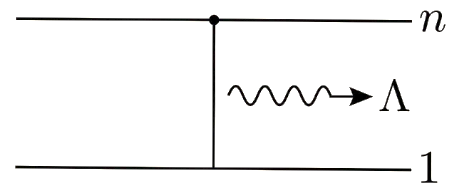
If wavelength of emitted photon in de-excitation is  ;
;
Then, 
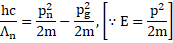
As energies are negative, we get


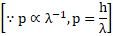
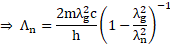


where,  and
and  are constants.
Prepare Smarter with CGP Edu
Get practice questions, solutions, and test series in one place.
Write a Review
Share your experience with this question and solution.
Commentary
Send your comment, doubt, correction, or feedback to admin.
Similar Questions
Explore conceptually related problems
Statement-I: When ultraviolet light is incident on a photocell, its stopping potential is and the …
If a source of power 4 kW produces photons/second, the radiation belongs to a part of the spectrum…
Energy required for the electron excitation in Li ++ from the first to the third Bohr orbit is :
After absorbing a slowly moving neutron of Mass (momentum ) a nucleus of mass breaks into two nu…
Hydrogen atom is excited from ground state to another state with principal quantum number equal to …
The anode voltage of a photocell is kept fixed. The wavelength λ of the light falling on the cathod…